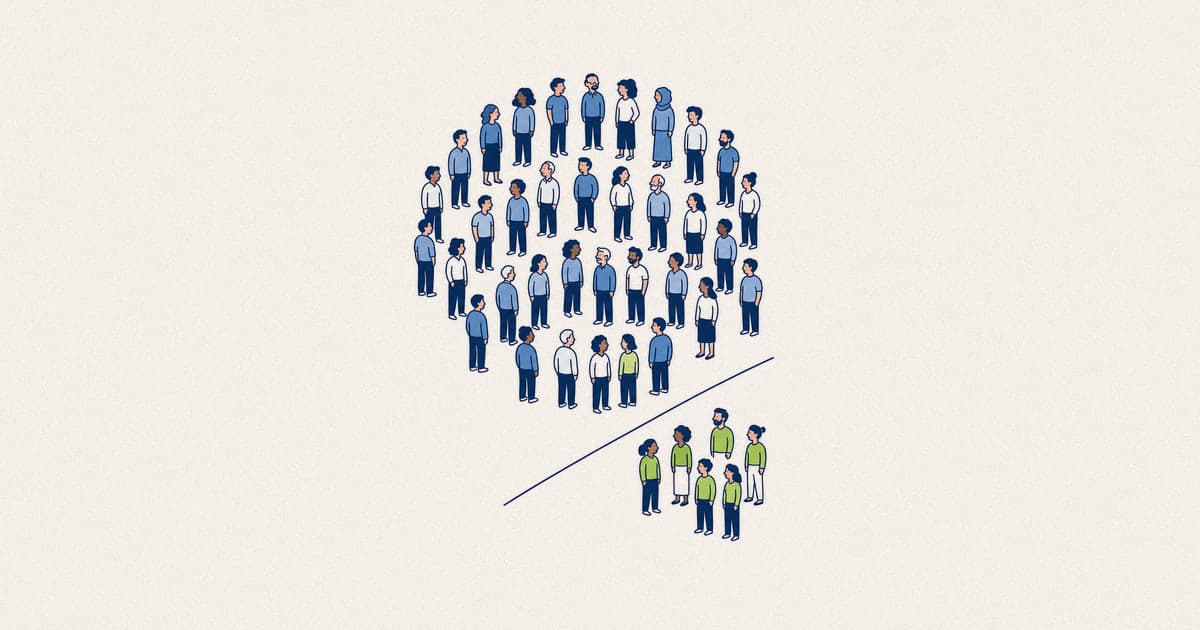
A VP of operations at a 210-person manufacturer had two internal candidates for a plant manager job. She ran a leadership assessment on both and asked us which one to promote.
No test answers that question. None ever claimed to.
Psychometric assessment is now routine in Canadian hiring. Good tool, badly used most of the time, because the test gets asked to decide instead of inform.
What a psychometric test actually measures
Four families of instruments, four different questions.
They are not interchangeable and the evidence is not equally strong. An ability test speaks to a learning curve. A work personality test speaks to how someone behaves when the pressure climbs. Confusing the two is the first mistake.

What it does not measure
Four things, usually the four people hope to find there.
Future performance. That depends on the manager, the mandate, the onboarding and the real workload. None of those exist on the day of the test.
Technical competence. A profile can flag high tolerance for ambiguity. Never whether someone can read an income statement. That is what a skills matrix is for.
Effort. Traits are stable. Motivation is not. A conscientious person goes quiet in a team where nothing gets decided.
A person's worth. There are no good and bad profiles, only profiles and contexts where they work better or worse.
A test does not tell you whether someone is good. It tells you how they operate. That difference is not academic, it is decisive.
The validity numbers, in plain terms
In 2022, Paul Sackett and colleagues recalculated the predictive validity of selection methods, correcting a decades-old statistical error. The ranking moved. The most recent analyses by Sackett and colleagues suggest that structured interviews carry higher predictive validity than cognitive ability tests once the latest statistical corrections are applied (SIOP).
Translate that. A coefficient of that order means the test explains only a limited share of the observed variation in performance. It is a decision-support tool, not a definitive answer.
Notice the order. The most predictive method is a structured interview. A test does not replace it, it improves it. A profile read the night before hands you three questions you would not have asked.
Using a test as a filter is misuse
Professional practice in Quebec points the same way: a selection decision should not rest on an assessment test alone (Ordre des CRHA). A rejected candidate can challenge the process, and an employer who cannot document its method defends itself badly.
A quieter risk: the ideal profile you screen against is usually the person who held the job last, and the job has changed.
Where the payoff actually is
Hiring gets the attention, but the strongest return is internal. A leadership assessment run on a management team before a restructuring, a succession plan or a strategic offsite surfaces what eighteen months of meetings never did. Two directors who keep clashing are usually not in conflict. They decide differently, and nobody has said it out loud.
Six conditions for a defensible assessment
- A validated instrument, normed on a population comparable to yours, not a free online quiz.
- A qualified professional administers and interprets it, as Quebec regulation requires.
- The test comes after a first interview, never before.
- The report is used to build the second interview.
- The candidate gets feedback on their own profile.
- The final call rests on at least three inputs: interview, references, assessment.
At Inlead RH (inleadrh.ca) our psychometric testing work runs on those six conditions, and we turn down mandates where the test is meant to rank people nobody has met. Not on principle. It does not work. If you are unsure where the problem sits, start with an HR self-assessment and read what your exit interviews already told you.